Thank you! Your submission has been received!
Oops! Something went wrong while submitting the form.

Latest News

Why Kurds refused to take their land from Iran during the war

The collapse of Washington’s projected Kurdish ground offensive highlights a critical systemic vulnerability in coalition-led proxy warfare strategies within the Middle Eastern theater. Faced with the limits of standalone deep-strike air campaigns to induce regime destabilization in Tehran, Western operational planning relied heavily on mobilizing transnational Kurdish networks to force a costly domestic troop diversion away from Iran's core security centers. However, this strategy collapsed due to a severe credibility deficit stemming from the prior abandonment of Syrian Kurdish forces, which structurally disincentivized regional proxies from absorbing initial kinetic retaliation without explicit, long-term security guarantees. By withholding active participation and explicitly denying cross-border operations, Kurdish leadership effectively paralyzed the opening of a western flank, leaving Western planners without a viable non-American ground force to exploit internal political friction points. Consequently, Tehran has successfully exploited this hesitation by executing pre-emptive precision strikes against opposition infrastructure in Iraq, neutralizing the threat before it could achieve operational cohesion. This outcome signals a long-term shift in regional power dynamics, establishing that early kinetic pressure can effectively deter indigenous proxy mobilization when the external sponsor's strategic commitment is perceived as unreliable.

Exclusive

Available to Insider Annual tier and higher.
Upgrade here to access.

By
RFU News
Jun 5, 2026

Mid-range strikes are creating death roads from Crimea to Mariupol to Donetsk

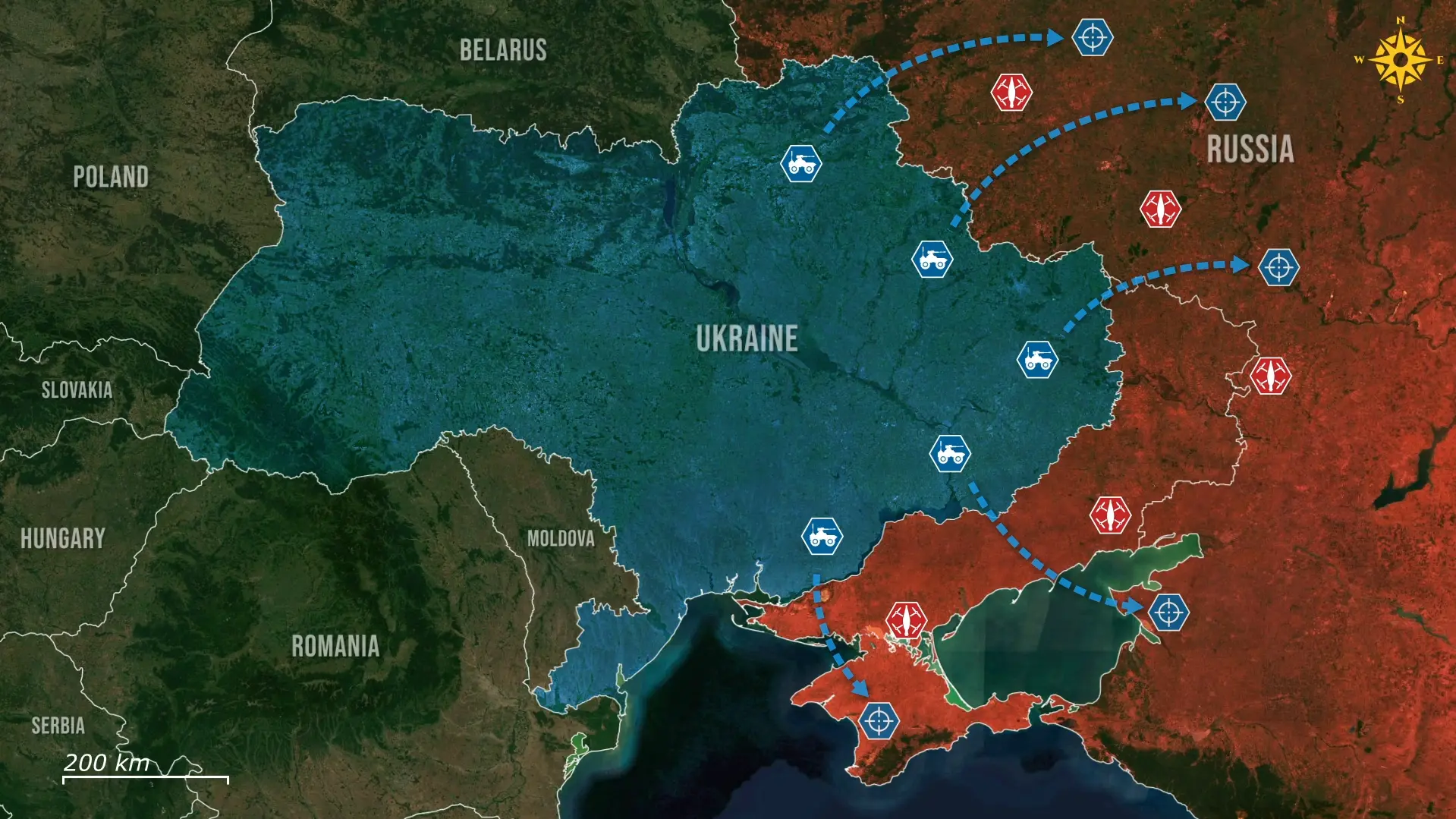
Ukraine’s maturation of a multi-layered, intermediate-range strike drone architecture has fundamentally reconfigured the theater-level logistics balance by imposing a structural "logistics lockdown" on Russian forces. By fielding a specialized third echelon of loitering munitions—such as the RAM X and Hornet platforms—capable of hunting moving targets between 30 and 150 kilometers behind the front lines, Ukraine has successfully eliminated Russia’s sanctuary in the near rear. This systemic degradation of critical ground lines of communication, specifically along the M-14, M-18, and M-30 highways, has systematically severed the operational continuity of the Azov Ring and the land corridor connecting Rostov-on-Don to Crimea. Operationally, this interdiction mechanics exploits a severe structural vulnerability: forcing the Russian military to displace its distribution nodes further backward exponentially increases cycle times, rapidly degrading its frontline combat mass and compounding artillery and fuel deficits in high-intensity axes like Pokrovsk and Donbas. Consequently, by exhausting localized Russian mobile air defenses and paralyzing the vehicular transport of fuel, ammunition, and reinforcements, this intermediate strike doctrine acts as a decisive force-multiplier that erodes Russia's attritional sustainability.

Exclusive

Available to Insider Annual tier and higher.
Upgrade here to access.

By
RFU News
Jun 4, 2026

The fires of revolution are not extinguished completely: US may be done, Iranians are not

The integration of decentralized satellite communication networks and localized asymmetric arms proliferation is fundamentally altering the systemic balance between the Iranian state security apparatus and domestic opposition forces. By neutralizing the state’s primary mechanism of centralized information blockades, resilient communication architectures have established a permanent, unjammable command-and-control framework that enables rapid cross-regional operational synchronization. Simultaneously, the introduction of small arms into peripheral regions has shifted anti-government dynamics from transient civilian protests to low-intensity, guerrilla-style asymmetric warfare. This operational evolution severely challenges the doctrine of the Islamic Revolutionary Guard Corps (IRGC), forcing a conventional security apparatus to pivot toward a resource-intensive, multi-front containment strategy against decentralized cellular threats. Consequently, the regime’s traditional reliance on brief, highly concentrated kinetic crackdowns is yielding diminishing strategic returns against a structurally resilient opposition. Over the long term, this paradigm shift ensures that internal instability will no longer manifest as manageable cycles of civil unrest, but as a permanent, logistically sustained degradation of state administrative and territorial control.

Exclusive

Available to Insider Annual tier and higher.
Upgrade here to access.

By
RFU News
Jun 3, 2026

Ukraine’s Gripen deal suddenly becomes much bigger!

The strategic introduction of Swedish JAS 39 Gripen fighter aircraft, paired with BVRAAM (Beyond-Visual-Range Air-to-Air Missile) Meteor technology, fundamentally alters the operational geometry of the Ukrainian theater. By embedding an aerial platform engineered specifically for dispersed, austere highway operations, Ukraine systematically mitigates its structural vulnerability to localized Russian ballistic and cruise missile infrastructure suppression. This logistics-light architecture enables high sortie generation rates from improvised, highly survivable launch points, directly challenging Russian regional kinetic dominance. Crucially, the deployment of the Meteor missile strips Russian tactical aviation of its primary offensive mechanism—standoff glide-bomb strikes—by extending the interception boundary up to 200 kilometers and enforcing a highly restrictive "no-escape zone". Concurrently, the long-term transition toward next-generation E/F variants equipped with advanced Active Electronically Scanned Array (AESA) radar and robust electronic warfare suites transforms Ukraine’s aerial posture from reactive, attritional survivability to proactive local air superiority. Ultimately, this comprehensive modernization package transitions the theater from a highly contested asymmetric environment into a structurally balanced domain capable of neutralizing deep Russian aerial power projection.

Exclusive

Available to Insider Annual tier and higher.
Upgrade here to access.

By
RFU News
Jun 2, 2026

No Results found

Please try different keywords