

.svg)
Russia usually presents Navy Day as a display of national strength, yet the reduced ceremony this year became a humiliating demonstration of how little naval power the Kremlin is allowed to expose. In Saint Petersburg, the traditional fleet parade was cancelled for the second consecutive year, leaving Putin to attend a reduced ceremony with roughly thirty sailors, a small military band, and a giant printed poster showing a Borei class nuclear submarine in place of real warships.
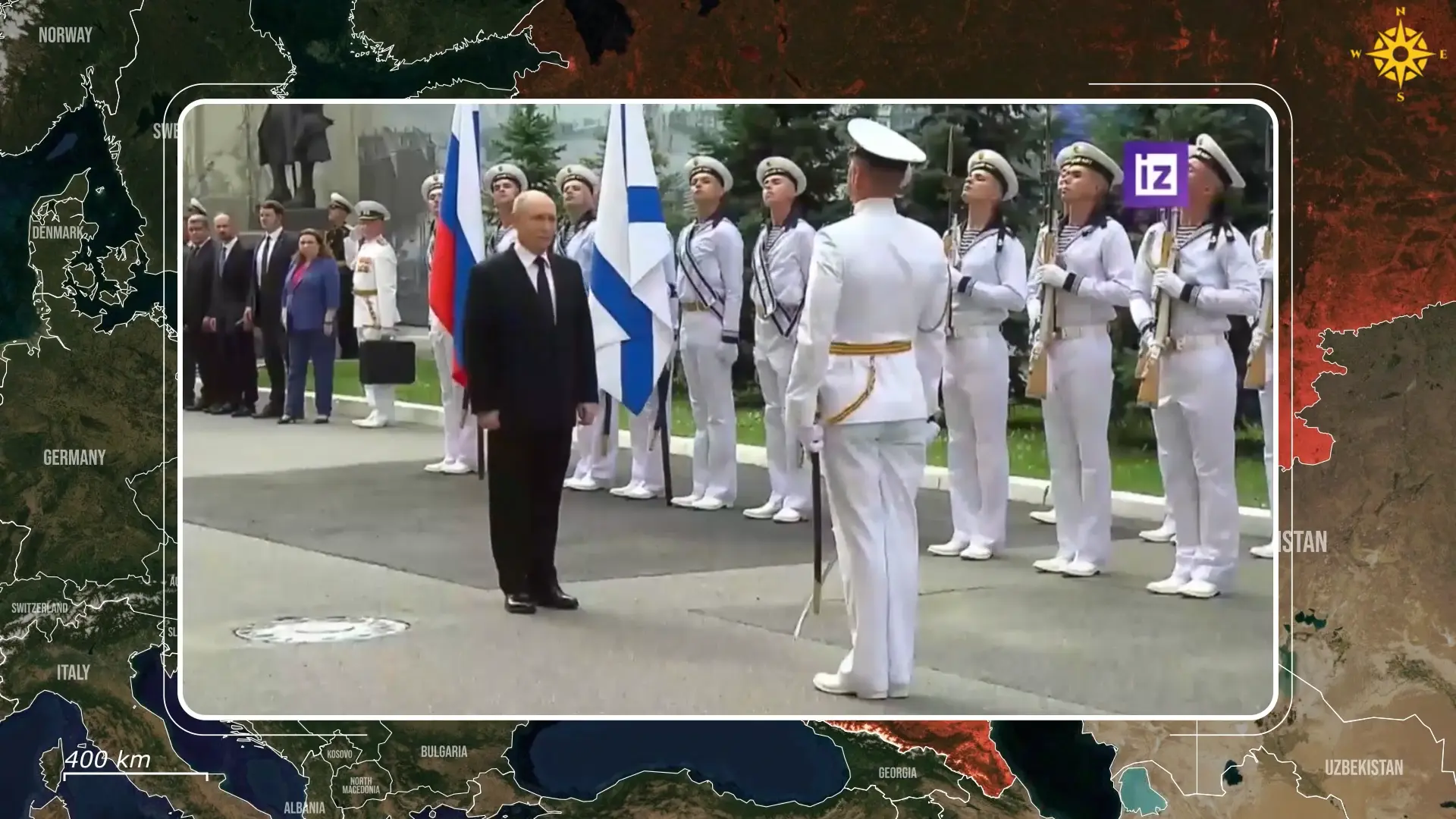
Besides the image, floating rafts with sailors standing on top were pushed through the water by two tugboats as part of the parade itself. Instead of ships, formations, and a presidential fleet review, the Kremlin offered an isolated photoshoot for Putin during the three hundred and thirtieth anniversary of the Russian Navy, turning a ceremony built around naval strength into a public image of naval vulnerability and humiliation.

Russian authorities cited security concerns when cancelling the parade, because assembling valuable warships along a publicly known route and schedule would have created a concentrated, predictable, and politically significant target for Ukrainian drones. By early two-thousand-twenty-six, roughly thirty percent of the Black Sea Fleet’s combat assets has been destroyed or otherwise taken out of commission, forcing Russia to relocate almost all of its combat ready vessels away from their historic base in Sevastopol and restricting their freedom of operation. Russian commanders feared the same result near Saint Petersburg for the Russian Baltic Fleet base, as Ukrainians have penetrated air defenses here on numerous occasions. As such, Russian political and military high command decided that the only way to protect the navy during Navy Day was to keep it out of view entirely.

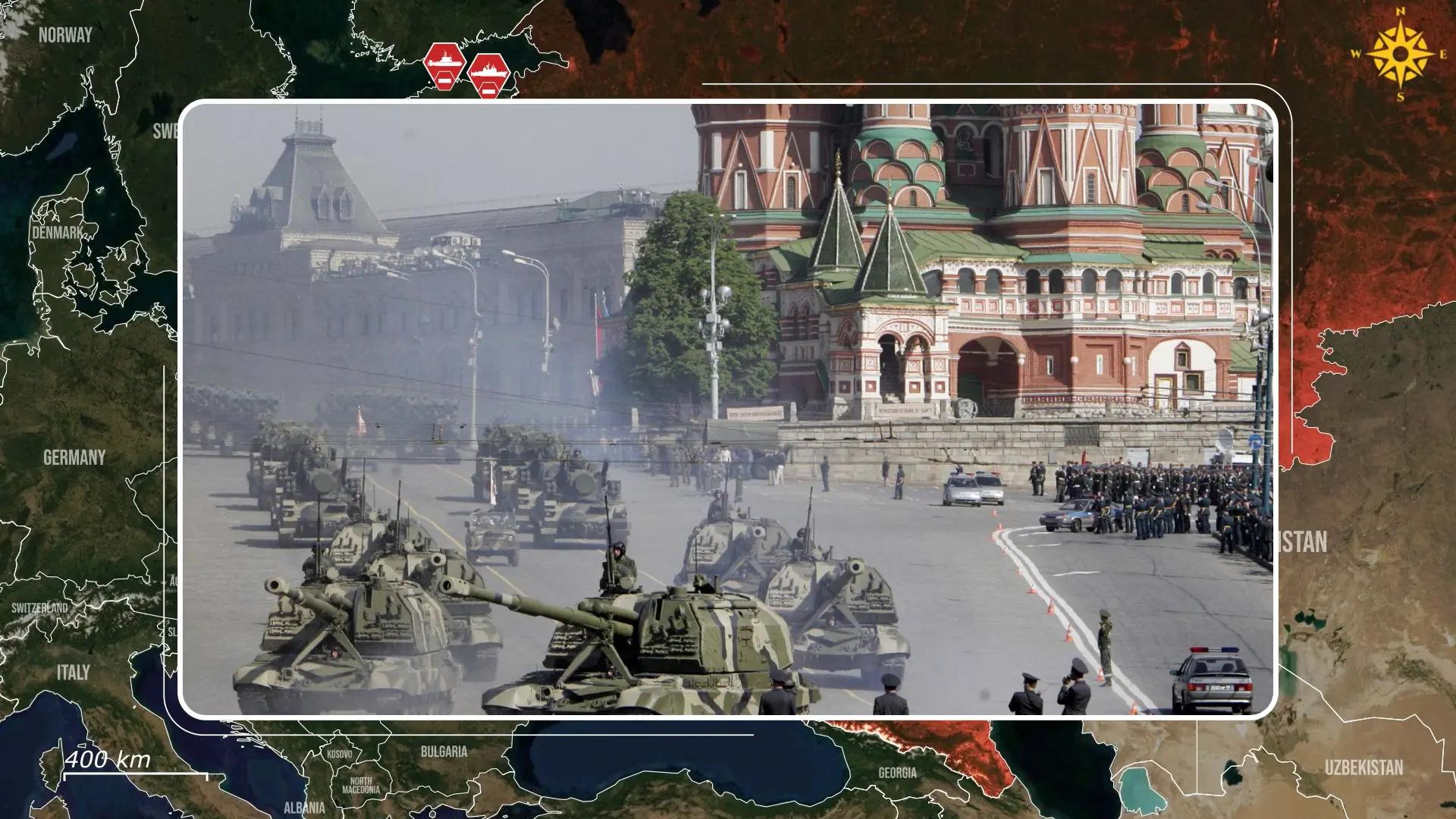
The same fear of Ukrainian strikes had already reshaped Russia’s most important military celebration two months earlier. During the May ninth Victory Day parade in Moscow, the Kremlin removed the usual mobile column of tanks, armored vehicles, and missile systems from Red Square. The Russian Defense Ministry attributed the reduction to the risk of Ukrainian strikes against Moscow and the equipment concentrated in Red Square. That threat had already been demonstrated when one drone reached a high rise building in the capital while Russian air defenses reported intercepting thirty two others, showing that even the airspace around Russia’s symbolic center could be penetrated. Soldiers still marched across Red Square, but the tanks, armored vehicles, and missile systems normally used to project Russian power appeared only as images on screens, just as Navy Day replaced a real submarine with a printed one. Removing the equipment avoided both physical losses and humiliating footage of an attack in central Moscow. Russia had now staged Navy Day without a fleet and Victory Day without its military hardware, revealing a sustained inability to conduct displays of strength in a society whose political identity is built heavily around military power.
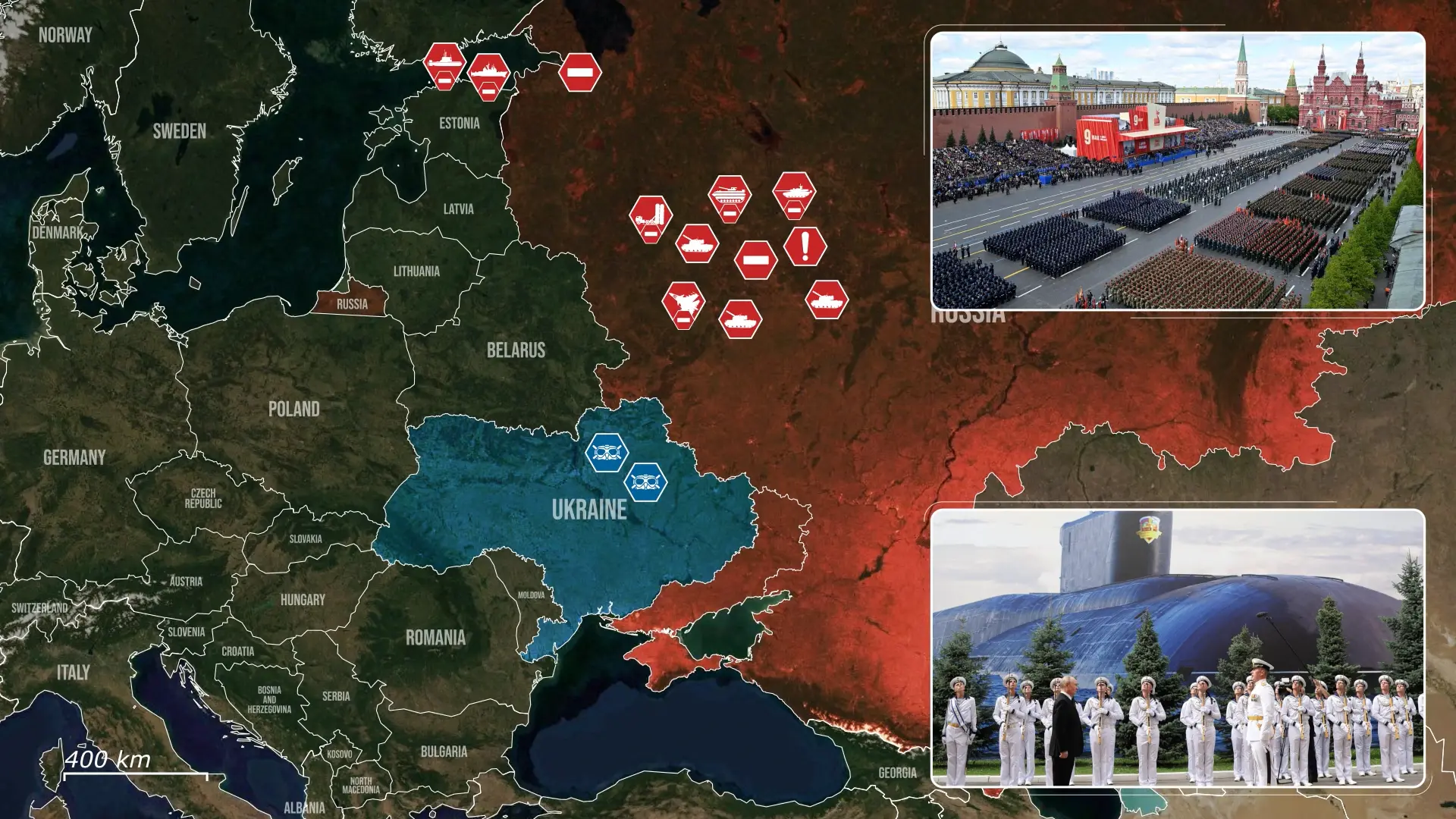
The disappearance of ships and weapons from Russia’s military ceremonies damages the Kremlin’s authority in the heavily militarized Russian society where military service, war imagery, historical victory, and loyalty to the armed forces are promoted as central public values. By returning heavy military equipment to Red Square in two thousand eight, Putin presented himself as the political heir to the Soviet victory over Nazi Germany and the commander of a restored great power. Navy Day reinforced the same image through warships, submarines, and formations designed to demonstrate global reach, naval resurgence, and Putin’s command over another branch of strategic power. These ceremonies displayed control through choreography, as the leadership summoned troops and valuable weapons, arranged them around Putin, and showed that the state could expose its military power without fear. Once the ships and weapons are replaced by screens and banners, that choreography loses its authority because the assets meant to prove fearlessness are visibly being protected from Ukraine. The reversal is especially damaging because Russia portrays Ukraine as a weak state that should have been defeated rapidly, while Ukrainian strike capabilities now determine what Putin can safely display in Moscow and Saint Petersburg.
Overall, Ukraine has gained the ability to make Russia censor its own military image before a strike is even launched. Navy Day without a fleet and Victory Day without military equipment showed that Putin could still order the celebrations to proceed, yet he could no longer safely produce the concentrated spectacle of ships, tanks, and missiles meant to prove his authority. Russian precautions achieved both a deterrence and propaganda effect before Ukraine needed to attack either ceremony. For Putin, that is more damaging than cancellation alone, as it shows that Russia’s leadership no longer fully controls when and where its military power can be assembled, even inside Moscow and Saint Petersburg.

.jpg)

Comments